Key Takeaways
- Self employed loans are available, but lenders often require additional documentation to verify your income.
- Most self employed home loan programs look for at least two years of income history, although some alternative lenders offer more flexible options.
- Keeping organized financial records, maintaining a healthy credit score, and lowering your debt-to-income ratio can improve your chances of approval.
- Loan options such as conventional, FHA, VA, USDA, and bank statement loans can help self-employed borrowers find the financing that fits their needs.
“Being self-employed means betting on yourself every single day. The road may be uncertain, but persistence, preparation, and belief in your vision can open doors you never thought possible.”
Signature Loans
Introduction
Millions of Americans are self‑employed from independent consultants and gig‑economy drivers to incorporated small‑business owners.
The U.S. workforce included roughly 16.8 million self‑employed people in 2025 (about 10.3% of all workers), and unincorporated self‑employed workers made up about 9.1 million individuals in 2024.
While running your own business gives you independence, it also complicates the process of getting a loan. Without W‑2 forms or pay stubs, you must prove your income differently and meet lenders’ documentation requirements.
Many self-employed borrowers ask, “Where can I find signature loans tailored for self-employed borrowers?” The answer often depends on how lenders evaluate income, documentation, and financial stability.
This guide answers common questions about self employed loans including how lenders define self‑employment, what documents they require, and how you can improve your chances of approval. It also looks specifically at self‑employed home loans so you know what to expect when buying a house.
Self Employed Loans: FAQs, Requirements, and Tips
Where can I find signature loans tailored for self-employed borrowers?
Self-employed borrowers can find signature loans through online lenders and loan marketplaces that work with non-traditional income sources. Unlike traditional lenders that rely heavily on pay stubs and employer verification, many lenders consider tax returns, bank statements, profit and loss statements, and 1099 income when reviewing applications.
At SignatureLoans.com, self-employed borrowers can explore signature loan options and connect with lending partners that understand the unique challenges faced by freelancers, independent contractors, gig workers, consultants, and small business owners. Even if your income comes from multiple sources, there may be financing options available that fit your situation.
Who counts as self‑employed for loan purposes?
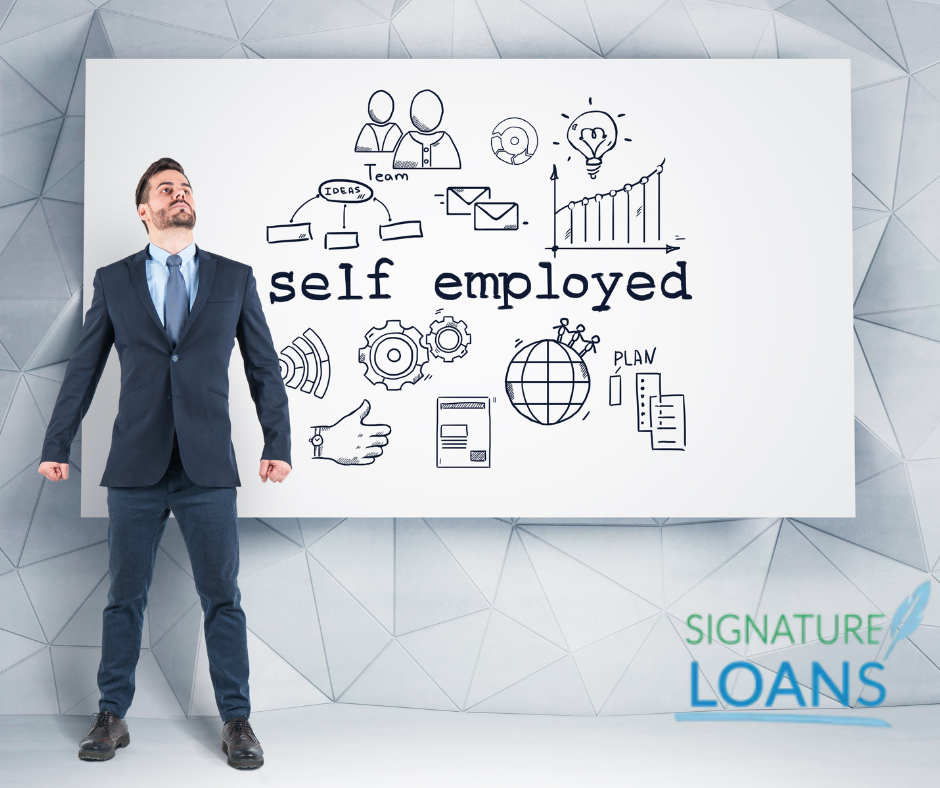
Lenders typically consider you self‑employed if you own 25% or more of a business, are paid on 1099s instead of W‑2s or report income on Schedule C.
This includes:
• Freelancers and sole proprietors: consultants, graphic designers, writers, photographers and other professionals paid directly by clients.
• Business owners and partners: individuals who own a significant stake in a partnership, S‑corporation or LLC (even if they pay themselves a salary).
• Gig‑economy workers: rideshare drivers, delivery couriers and independent contractors who take short‑term jobs.
• Real‑estate investors: people who own and manage rental properties.
If you fit into any of these categories and earn your income outside of a traditional employer–employee relationship, lenders will treat you as self‑employed.
Why is it harder to get approved when you’re self‑employed?
Traditional employees have predictable pay stubs and employer‑verified income.
Self‑employed borrowers often have fluctuating income, extensive tax deductions and no W‑2s, which makes underwriters wary.
Mortgage lenders look for assurances that your income is steady enough to meet monthly payments.
Because your income may swing from one month to the next, lenders require more documentation and may ask you to average your net income over two years.
What are the basic eligibility requirements for self employed loans?
Credit score
Most lenders require a minimum credit score of around 620 for conventional loans. However, higher scores (often 660–760) provide better rates and terms, and some bank‑statement and portfolio lenders require 680 or above.
FHA loans accept scores as low as 580, and some lenders may go down to 500 with a 10% down payment. VA loans technically have no minimum, though most lenders look for 580–620.
Self‑employment history
A common requirement is at least two years of self‑employment. Truss Financial notes that many lenders want at least two years of consistent income.
Although two years of self‑employment is standard, exceptions exist for those with similar prior work in the same field.
Some non‑qualified‑mortgage (non‑QM) lenders or portfolio programs will consider one year of self‑employment with strong financials, but you’ll likely pay higher rates.
Debt‑to‑income (DTI) ratio
Your DTI ratio compares total monthly debt payments to gross monthly income.
Conventional mortgages typically cap DTI around 43–50%, while FHA loans may allow up to 50–57% with compensating factors.
A lower DTI signals better repayment ability.
Cash reserves
Lenders often want to see 6–12 months of mortgage payments in savings.
Reserves cushion against income disruptions and show you can continue paying if business slows down.
Proof of income
Self‑employed borrowers must show reliable income.
Expect to provide:
• Two years of tax returns, including all schedules (e.g., Schedule C for sole proprietors, Schedule E for rental income, K‑1s for partnerships).
• Profit‑and‑loss statements and year‑to‑date financials, ideally prepared or signed by a CPA.
• Bank statements showing consistent deposits over the last 12–24 months.
• 1099 forms and business licenses or proof of self‑employment.
Lenders usually use net income (income after business deductions) to evaluate eligibility.
That means tax write‑offs that reduce your taxable income can also reduce your qualifying income.
Some lenders average your net income over two years or may weight the most recent year more heavily if income is rising.
What are loan options for self-employed people?
There are many types of loans that people with any kind of job might seek depending on their financial needs and goals.
Secured loans, including a mortgage, car loan, or boat loan, can use property or assets as collateral to help guarantee the loan. Other loans are unsecured, meaning they’re approved based on the financial history of the borrower.
If you’re self employed and looking to cover living expenses, new equipment, or other important purchases, you have several possibilities. Below are some loan options you might consider, depending on your situation.
Personal loan
Personal loans offer flexibility for a variety of uses, such as unexpected expenses and debt consolidation. They also offer flexible repayment terms, a fixed interest rate, and a set monthly payment.
Credit cards
Whether you’re a gig worker, freelancer, independent contractor, or small business owner, you can use credit cards to pay for expenses. However, these often have higher interest rates than other types of loans which could lead to a lot in interest over time.
You could also consider using a credit card for a cash advance, which lets you borrow against your available credit limit. However, keep in mind that you might start accruing interest from the transaction date, and there could be a service fee.
Secured loan or line of credit
If you own a business or have other assets, you may be able to use those as collateral for a secured loan.
By securing the loan with a dedicated savings account, a car, boat, or other asset, you can potentially request more money with longer repayment terms.
A secured loan can be structured as a lump sum or a line of credit, which allows you to borrow repeatedly up to your credit limit.
Small business loan
If you’re a sole proprietor or own an LLC, a traditional small business loan might be an option. Small business loans can be used for many purposes, such as buying new equipment and real estate purchases.
These loans can be obtained from several sources, including banks, credit unions, online lenders, and community nonprofits.
You can also research the U.S. Small Business Administration (SBA), which offers several loan programs.
For instance, an SBA micro loan provides up to $50,000 to help small businesses grow but can’t be used to buy real estate or pay existing debts.
Which home loan programs are available for self‑employed borrowers?
Conventional loans
Conventional loans offer flexibility on property types and higher loan limits, and you can avoid private mortgage insurance by putting 20% down.
To qualify, Uqual thinks you generally need 620+ credit, 3–20% down and DTI below 45–50%.
Self‑employed applicants must document at least two years of income and meet standard underwriting guidelines.
FHA loans
Insured by the Federal Housing Administration, FHA loans are popular with self‑employed borrowers because of their 3.5% down‑payment option for credit scores ≥580.
FHA loans allow higher DTI ratios (up to about 50–57%) and more lenient credit scores, but every FHA loan requires mortgage insurance premiums (MIP).
You still need to show two years of business history or one year with two years in the same field.
VA loans
For eligible veterans and active‑duty service members, VA loans offer unmatched benefits:
No down payment, no PMI, flexible DTI guidelines and interest rates typically 0.25–0.5% lower than conventional loans.
The Department of Veterans Affairs sets no official credit‑score minimum, but most lenders require around 580–620.
USDA loans
USDA Rural Development loans allow zero down payment in eligible rural areas.
They generally require credit scores around 640 and enforce a strict DTI cap of about 41%. These loans work well for self‑employed borrowers buying in rural communities, but they’re less forgiving of low taxable income.
Bank‑statement loans and other non‑QM options
When tax returns don’t reflect your true earnings (due to large deductions), bank‑statement loans can be a lifesaver.
Instead of tax forms, lenders analyze 12–24 months of bank statements and apply an expense factor to estimate your income.
For example, a contractor with $180,000 in annual deposits might qualify based on $108,000 in income if the lender applies a 40% expense factor.
These loans usually require 10–40% down, credit scores between 660 and 760 and maximum DTI around 45%. Because they fall outside standard guidelines, rates may be higher.
Portfolio loans and other non‑QM programs offer similar flexibility. They’re often issued by private investors who hold the mortgages themselves.
These lenders may accept one year of self‑employment or lower credit scores, but they charge higher rates and usually require larger down payments.
They’re useful for borrowers who don’t meet conventional guidelines due to recent bankruptcies, foreign income or lack of a Social Security number.
What documents should you gather before applying?
Here’s a practical self‑employed loan application checklist:
• Personal and business tax returns for the last two years, including all schedules and IRS transcripts.
• Year‑to‑date profit‑and‑loss statement, signed and dated by you or your CPA.
• Business bank statements (usually the two most recent months) showing cash‑flow consistency.
• 1099 forms for freelance or contract income.
• K‑1 statements if you own part of a partnership or S‑corporation.
• Business license or proof of self‑employment, such as articles of organization or a city business permit.
• Signed CPA letter confirming your business existence and income trends (optional but helpful).
• Valid ID and credit documentation (recent credit report).
Organizing these documents before you apply will make the underwriting process smoother and show lenders you’re serious.
How do lenders calculate your qualifying income?
Underwriters typically average your net business income over the past two years.
For example, if your net income was $85,000 one year and $92,000 the next, the average is $88,500 per year or $7,375 per month.
If your income is trending upward, some lenders may emphasize the most recent year; if it’s trending downward or seasonal, be prepared to explain why.
Keep in mind that depreciation and other non‑cash deductions may be added back to net income for qualification purposes.
What’s unique about self employed home loans?
A self‑employed home loan is a mortgage designed for individuals who operate their own businesses.
The underwriting process focuses on verifying your income and assessing your ability to handle the monthly mortgage.
Compared with personal loans or credit cards, mortgage lenders require far more documentation and consider long‑term stability.
The requirements discussed above credit, DTI, reserves and documentation apply specifically to home loans.
For other self employed loans such as personal loans, business lines of credit or equipment financing, lenders may weigh cash flow and credit history but don’t follow mortgage‑specific guidelines.
How can you improve your chances of approval?
• Separate your business and personal finances. Use dedicated business bank accounts and credit cards so income and expenses are easy to track.
• Optimize your credit score. Pay bills on time, keep credit utilization below 30% and avoid closing long‑standing accounts. Dispute any errors on your credit report.
• Lower your DTI. Reduce debt by paying down credit cards or delaying large purchases until after your loan closes.
• Build cash reserves. Save enough to cover your down payment plus 6–12 months of mortgage payments.
• Work with a CPA or tax professional. Accurate profit‑and‑loss statements and organized financials lend credibility. A CPA letter verifying your self‑employment history and income trends can strengthen your application.
• Be ready to explain income fluctuations. Seasonal or inconsistent earnings aren’t deal‑breakers if you can show a pattern and provide context.
• Consider non‑QM lenders if needed. Bank‑statement and portfolio loans can bridge the gap when tax returns don’t tell the whole story. Accept that these loans often come with higher rates and larger down‑payment requirements.
How long must I be self‑employed to get a mortgage?
Most lenders want to see two years of self‑employment.
Some will accept one year of self‑employment with at least two years of prior experience in the same line of work, but you may need a larger down payment and stronger credit profile.
A few portfolio lenders consider one‑year histories, especially if your business is stable.
Do lenders use net or gross income for self employed home loans?
Lenders usually base your qualifying income on net business income after deductions.
This can feel unfair when write‑offs lower your taxable income.
Bank‑statement loans calculate income differently by applying an expense factor to your deposits.
Can I get a mortgage if my income fluctuates?
Yes. Lenders understand that self‑employment income varies.
They will average your income over 24 months and may require you to explain any large swings or seasonal patterns.
Consistent cash reserves and a stable credit profile can offset volatility.
Are there self employed loans for home renovations or refinancing?
Self‑employed borrowers can access conventional, FHA, VA, USDA and bank‑statement loans for refinancing or cash‑out purposes as long as they meet the credit and income requirements.
HELOCs (home‑equity lines of credit) and home‑equity loans can also be available; lenders evaluate similar documentation but may be more flexible on DTI.
What if I’m a new entrepreneur with less than one year of tax returns?
New business owners will have difficulty qualifying for a mortgage.
Your best options are to build a history first: open business bank accounts, keep detailed financial records, improve your credit and save cash reserves.
Non‑QM lenders may consider strong bank‑statement or asset‑based loans, but expect higher rates and down‑payment requirements.

Ready to Apply for a Self Employed Loan?
Getting approved for self employed loans may take a little extra preparation, but it’s absolutely possible.
With the right documentation, steady income, and a strong financial profile, you can qualify for financing that supports your personal or business goals.
Whether you’re applying for a self employed home loan or another type of financing, understanding the process ahead of time can help you move forward with confidence.
Apply for a Business Signature Loan
The information above is provided for general educational purposes. Always review the terms and conditions of any loan and consult a financial advisor if needed.