Key Takeaways
- A signature loan is generally a type of unsecured personal loan.
- Personal loans are a broader category that may include both secured and unsecured loans.
- Signature loans do not require collateral, but qualification may depend on credit, income, existing debts, and ability to repay.
- Secured personal loans require collateral and may offer different rates or qualification requirements.
- Compare the APR, fees, monthly payment, repayment term, and total repayment amount before accepting any loan.
“The right loan is not simply the one you can qualify for, It is the one whose cost and repayment schedule fit your financial plan.”
Signature Loans
Introduction
When comparing a signature loan vs personal loan, the two terms may appear to describe completely different financial products. In reality, a signature loan is generally one specific type of personal loan.
A personal loan may be secured by collateral or offered without collateral. A signature loan is unsecured, meaning the lender approves the loan based primarily on the applicant’s creditworthiness, income, existing financial obligations, and promise to repay.
Understanding this relationship can help you compare loan offers accurately and choose an option that fits your needs without putting unnecessary pressure on your budget.
Signature Loan vs Personal Loan: Differences, Costs and Requirements
What Is a Signature Loan?
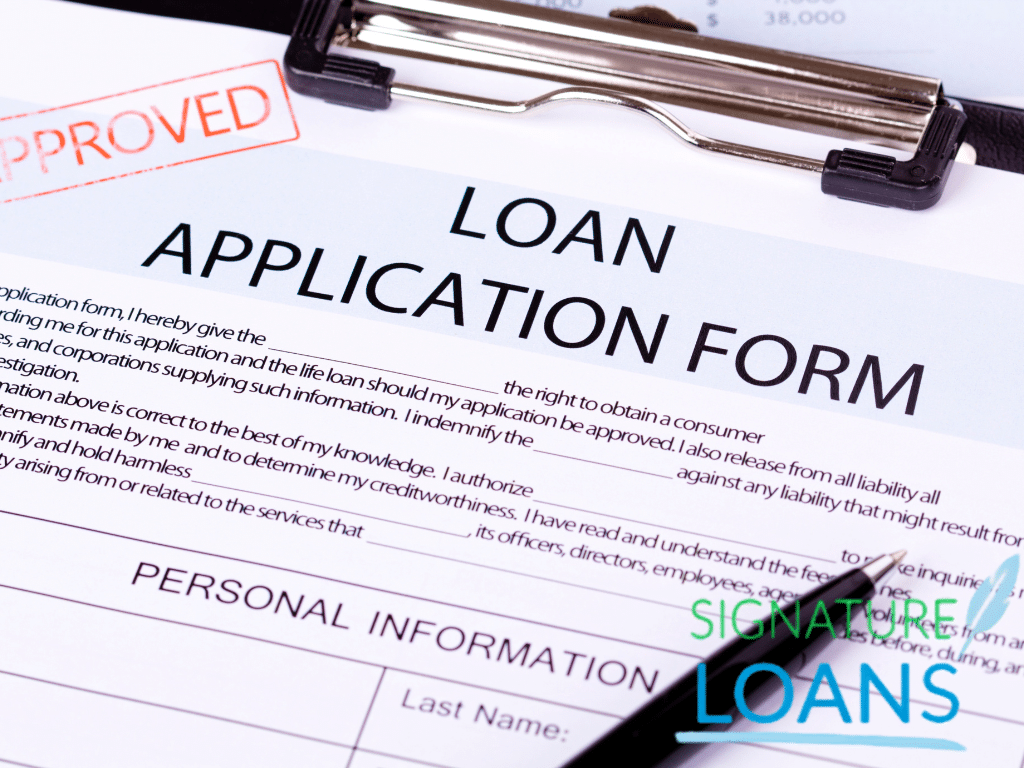
A signature loan is an unsecured personal loan that does not require the borrower to pledge an asset such as a vehicle, savings account, or other property as collateral.
The name comes from the borrower signing an agreement and promising to repay the debt according to its terms. However, a signature alone is not enough to qualify.
The lender may also evaluate:
- Credit history and credit score
- Income and employment
- Debt-to-income ratio
- Monthly financial obligations
- Requested loan amount
- Repayment history
- State of residence
- Overall ability to repay
If approved, the borrower generally receives a lump sum and repays it through scheduled installments.
The Consumer Financial Protection Bureau defines a personal installment loan as money borrowed and repaid in fixed amounts known as installments.
What Is a Personal Loan?
A personal loan is money borrowed for personal rather than business purposes. Depending on the lender and product, a personal loan may be either secured or unsecured.
Personal loans are commonly used for:
- Emergency expenses
- Medical or dental bills
- Vehicle repairs
- Debt consolidation
- Home improvements
- Moving expenses
- Major purchases
- Other eligible personal expenses
The loan agreement determines the amount, interest rate, fees, repayment term, payment schedule, and permitted use of the funds.
Secured Personal Loans
A secured personal loan requires the borrower to pledge an asset as collateral. Depending on the product, the collateral might be a savings account, certificate of deposit, vehicle, or other valuable property.
If the borrower defaults, the lender may have the right to take the collateral to recover the unpaid debt.
Collateral may reduce the lender’s risk, which could result in different rates or qualification requirements. However, approval and favorable terms are not guaranteed.
Unsecured Personal Loans
An unsecured personal loan does not require collateral. Instead, qualification is generally based on the applicant’s credit and financial profile.
Because the lender cannot claim a specifically pledged asset if the borrower defaults, unsecured financing may carry higher rates than comparable secured financing. The actual cost depends on the lender, applicant, amount, and loan terms.
A signature loan falls within this unsecured category.
What Is the Main Difference Between a Signature Loan and a Personal Loan?
The main difference is their scope:
- Personal loan is the broader category.
- Signature loan usually refers to an unsecured personal loan approved without collateral.
This means all signature loans are generally personal loans, but not all personal loans are signature loans.
A personal loan secured by a savings account or another asset would not usually be described as a signature loan.
The terms “signature loan,” “unsecured personal loan,” and “personal installment loan” may sometimes be used interchangeably in advertising.
Always examine the actual agreement rather than relying only on the product’s name.
Signature Loan vs Personal Loan Comparison
| Feature | Signature Loan | Personal Loan |
|---|---|---|
| Product category | A type of unsecured personal loan | A broad category of consumer loan |
| Collateral | Generally not required | May be secured or unsecured |
| Typical structure | Usually a lump sum repaid in installments | Structure depends on the particular product |
| Qualification | May consider credit, income, debts, and ability to repay | Depends on whether the loan is secured or unsecured |
| Risk to property | No specifically pledged collateral | Collateral may be at risk with a secured loan |
| Rates and fees | Depend on lender and applicant qualifications | Depend on the loan type, lender, collateral, and applicant |
| Use of funds | Often flexible, subject to the agreement | Often flexible, subject to the agreement |
| Credit impact | Application and payment activity may affect credit | Application and payment activity may affect credit |
How Does a Signature Loan Work?
A signature loan generally follows these steps:
1. Submit a Loan Request
You provide personal, financial, employment, income, and bank-account information. You may also need to explain the requested amount and intended purpose.
2. Complete the Lender’s Review
The lender may review your credit report, income, employment, current debts, and ability to make the required payments.
Submitting a request does not guarantee approval or a particular offer.
3. Review the Loan Agreement
If approved, you should receive information about the loan amount, APR, fees, payment schedule, repayment term, and total cost.
4. Accept or Decline the Offer
You are not required to accept a loan simply because a lender approves your application. Review the complete agreement before signing.
5. Receive the Funds
If you accept the agreement and complete all verification requirements, the lender may deposit the proceeds into your bank account.
Funding time varies according to the lender, application, time of approval, and bank processing.
6. Make Scheduled Payments
You repay the loan according to the agreement. Late or missed payments could result in fees, collection activity, and harm to your credit.
How Does a Secured Personal Loan Work?
A secured personal loan follows a similar application and repayment process, but the borrower must provide acceptable collateral.
The lender may evaluate:
- The value of the collateral
- The applicant’s credit profile
- Income and existing debts
- The requested amount
- The ability to repay
If approved, the lender places a claim or security interest on the asset. That interest may remain until the loan has been repaid.
A secured loan could offer a lower rate or make qualification easier for some applicants, but it introduces the risk of losing the pledged property after default.
Is a Signature Loan Better Than a Personal Loan?
A signature loan is not necessarily better because it is already a form of personal loan. A more useful question is whether an unsecured signature loan or a secured personal loan better suits your situation.
A signature loan may be appropriate when:
- You do not want to pledge property.
- You need a lump sum for an eligible personal expense.
- You qualify for an affordable rate and payment.
- You prefer a predictable repayment schedule.
- You can repay the debt without disrupting essential expenses.
A secured personal loan may be worth considering when:
- You have acceptable collateral.
- You are comfortable placing that property at risk.
- The secured offer has a meaningfully lower total cost.
- You understand the consequences of default.
- The payment fits comfortably within your budget.
The best choice depends on the actual offers available to you not only the product labels.
What Are the Advantages of a Signature Loan?
No Collateral Is Required
You generally do not have to pledge a vehicle, savings account, or other specific asset.
Flexible Use of Funds
Depending on the loan agreement, proceeds may be used for various personal expenses.
Predictable Payments
Many signature loans are installment loans with scheduled payments, which may make budgeting easier.
Potentially Simpler Application
Without collateral to inspect or value, the process may require fewer asset-related steps than some secured loans.
Opportunity to Build Credit
If the lender reports to consumer credit bureaus, making payments as agreed may help establish a positive payment history. Late payments and defaults can have the opposite effect.
What Are the Disadvantages of a Signature Loan?
Rates May Be Higher
Because there is no collateral, lenders may charge more to account for the additional risk.
Qualification May Be More Difficult
Applicants with limited or damaged credit may receive fewer offers, higher costs, or smaller amounts.
Fees May Apply
Depending on the lender, a loan may include origination, documentation, late-payment, returned-payment, or other fees.
The Loan Still Creates a Legal Obligation
“Unsecured” does not mean that repayment is optional. A lender may report missed payments, send the debt to collections, or pursue other remedies permitted by law and the agreement.
Borrowing Can Strain Your Budget
A new installment payment could make it harder to cover rent, utilities, transportation, food, or other necessary expenses.
What Are the Advantages of a Secured Personal Loan?
A secured personal loan may offer:
- Different qualification requirements
- Potentially lower rates
- Access to a larger amount in some cases
- An opportunity for an applicant with limited credit to demonstrate repayment ability
These are potential benefits, not guarantees. The actual offer depends on the applicant, collateral, lender, and loan terms.
What Are the Disadvantages of a Secured Personal Loan?
The primary disadvantage is the risk to your collateral. If you fail to repay the loan, the lender may be able to take the pledged asset.
Additional disadvantages may include:
- Collateral appraisal requirements
- Restrictions on acceptable assets
- Additional documentation
- A longer application process
- Fees associated with securing the loan
- Limits on selling or transferring the collateral
Do not pledge an asset you cannot afford to lose without carefully evaluating the risk.
Do Signature Loans Have Higher Interest Rates Than Personal Loans?
This question can be misleading because a signature loan is a personal loan.
A signature loan may carry a higher rate than a secured personal loan because no collateral reduces the lender’s potential loss. However, it may have a lower rate than another unsecured product, depending on the borrower and lender.
Rates may be influenced by:
- Credit score and credit history
- Income
- Debt-to-income ratio
- Loan amount
- Repayment term
- Lender policies
- State law
- Whether collateral is provided
- Current market conditions
Compare the APR rather than looking only at the stated interest rate.
The CFPB explains that an APR incorporates the interest rate and certain additional loan fees, making it a more useful measure of borrowing cost.
What Fees Can a Signature or Personal Loan Include?
Possible charges include:
- Origination fees
- Application or documentation fees
- Late-payment fees
- Returned-payment fees
- Check-processing fees
- Prepayment penalties, where permitted
- Collateral-related costs on secured loans
A fee may be deducted from the loan proceeds. For example, if a lender approves a certain amount but deducts an origination fee before disbursement, you will receive less than the face value of the loan.
The CFPB recommends reviewing the required disclosures and loan documents and comparing offers from multiple lenders before agreeing to a personal installment loan.
How Much Can You Borrow With a Signature Loan?
There is no universal signature-loan amount.
The amount available depends on:
- The lender’s minimum and maximum amounts
- The applicant’s credit profile
- Verified income
- Current debts
- State availability
- Ability to repay
SignatureLoans.com may help qualified applicants explore personal signature-loan options of up to $5,000 or more, depending on the lender and applicant qualifications.
An available amount is not necessarily an affordable amount. Borrow only what you reasonably need and can repay.
What Credit Score Is Needed for a Signature Loan?
There is no single minimum score used by every lender. Each lender establishes its own requirements and may consider more than the score alone.
An applicant with a stronger credit profile may have access to more favorable rates or terms, while someone rebuilding credit may receive fewer or more expensive offers.
Other factors may include income, debt, employment, and repayment ability.
Be cautious of websites claiming that a specific score guarantees approval.
Can You Get a Signature Loan With Bad Credit?
Some lenders consider applicants across a range of credit profiles, including borrowers rebuilding credit. However, approval is not guaranteed.
Bad credit may lead to:
- Fewer available offers
- A higher APR
- A smaller loan amount
- A shorter repayment term
- Additional verification
- A payment that may be difficult to afford
Before accepting an expensive loan, compare lower-cost alternatives and calculate how the scheduled payments would affect your monthly budget.
Does Applying for a Signature Loan Affect Your Credit?
It depends on the type of credit inquiry.
Some providers use a soft inquiry during prequalification, which generally does not affect a credit score. A formal application may require a hard inquiry, which can affect the score.
If the loan is opened and reported to credit bureaus, payment history and account activity may also influence your credit over time.
Ask whether the initial request or subsequent application will result in a hard credit inquiry before proceeding.
Can a Signature Loan Be Used for Debt Consolidation?
Yes, if the lender allows the intended use. A borrower may use a signature loan to combine qualifying balances into one scheduled payment.
Consolidation may be useful if the new loan provides:
- • A lower overall cost
- • A manageable monthly payment
- • A clear payoff date
- • Fewer accounts to monitor
A smaller monthly payment does not always mean that the loan is less expensive. Extending repayment over a longer period can increase the total interest paid.
Debt consolidation is also less likely to help if the borrower immediately builds new balances on the accounts that were paid off.
Can a Signature Loan Be Used for an Emergency?
Depending on the lender’s permitted uses.
A signature loan may help with an urgent expense such as:
- A medical bill
- Essential vehicle repairs
- Necessary home repairs
- An unexpected move
- A temporary income interruption
- Another qualifying personal expense
Consider whether the expense can be reduced, delayed, divided into payments, or covered by an assistance program before borrowing.
Funding times vary. No lender or matching service should guarantee approval or a particular funding date before completing its review.
How Do Signature Loans Compare With Credit Cards?
A signature loan generally provides a lump sum with an established repayment schedule. A credit card offers revolving credit that can be used repeatedly up to the available limit.
A signature loan may be more appropriate for a defined expense with a known cost. A credit card may provide flexibility for smaller or recurring purchases.
Compare:
- APR
- Fees
- Required payment
- Repayment period
- Total expected cost
- Whether the rate is fixed or variable
- The temptation to continue borrowing
How Do Signature Loans Compare With Lines of Credit?
A signature loan usually provides the entire approved amount at once. A personal line of credit allows the borrower to draw funds as needed, subject to the available limit and agreement.
A line of credit may be useful for recurring or uncertain expenses, while an installment loan may be easier to plan around when the expense is known.
Lines of credit may have variable rates and changing payment amounts. Review the agreement carefully.
How Do Signature Loans Compare With Payday Loans?
Signature loans and payday loans are generally structured differently.
A signature loan is commonly repaid through installments over a defined term. A payday loan typically involves a relatively small amount due on or near the borrower’s next payday.
Payday loans can be substantially more expensive. The CFPB notes that a typical two-week payday loan charging $15 per $100 borrowed produces an APR of almost 400%. State laws, fees, maximum amounts, and availability vary.
Before using a payday loan, compare personal installment loans, credit-union options, creditor payment plans, employer assistance, and community resources.
What Documents Are Needed for a Signature Loan?
Requirements differ, but a lender may request:
- Government-issued identification
- Social Security number
- Proof of address
- Employment information
- Recent pay stubs or other proof of income
- Bank-account information
- Information about housing expenses
- Details of existing debts
- Additional documents needed to verify the application
Submitting complete and accurate information may reduce verification delays, but it does not guarantee approval.
How Do You Apply for a Signature Loan?
1. Determine How Much You Need
Calculate the actual expense and avoid borrowing more simply because a larger amount may be available.
2. Review Your Budget
Make sure the payment will fit alongside housing, utilities, food, transportation, insurance, and existing debts.
3. Check Your Credit Reports
Review your reports for inaccurate information before applying.
4. Compare Providers
Possible sources include banks, credit unions, online lenders, and lender-network services such as SignatureLoans.com.
5. Ask About Credit Inquiries
Determine whether checking potential options requires a soft or hard inquiry.
6. Prepare Your Documents
Gather identification, income documentation, employment details, and bank information.
7. Compare Offers
Review the APR, fees, payment schedule, term, total repayment amount, and consequences of late or missed payments.
8. Read Before Signing
Do not accept an offer until you understand the complete agreement.
How Can You Compare Loan Offers?
When comparing a signature loan vs personal loan.
Consider:
- Amount requested
- Amount received after fees
- APR
- Interest rate
- Origination fee
- Monthly payment
- Number of payments
- Repayment term
- Total repayment amount
- Fixed or variable rate
- Collateral requirement
- Late and returned-payment fees
- Prepayment provisions
- Credit-reporting practices
The loan with the lowest monthly payment is not automatically the least expensive. Compare the complete cost and how long you will remain in debt.
How Can You Avoid Personal-Loan Scams?
Be cautious if a company:
- Guarantees approval before reviewing your application
- Demands an upfront payment to release loan proceeds
- Requests payment through gift cards, cryptocurrency, or wire transfers
- Contacts you unexpectedly about a loan you did not request
- Refuses to provide written terms
- Pressures you to act immediately
- Has no verifiable address or contact information
The Federal Trade Commission warns that legitimate lenders do not guarantee financing before reviewing an application.
Requests for upfront “insurance,” “processing,” or paperwork payments in exchange for a promised loan are common signs of an advance-fee scam.
Frequently Asked Questions About Signature loans vs Personal loans
Can I apply online for signature loans and personal loans from major providers?
Yes. Many banks, credit unions, online lenders, and loan-network services offer online applications. You can also submit an online personal signature-loan request through SignatureLoans.com. Approval, available terms, and funding times vary and are not guaranteed.
Which financial institutions offer unsecured personal loans?
Unsecured personal loans may be available from banks, credit unions, online lenders, and lender-network services. Availability and requirements depend on the institution, applicant’s state, credit profile, income, existing debts, and ability to repay.
Which lenders offer the best rates for signature loans compared to personal loans?
There is no single lender offering the best rate for everyone. Your lowest available rate may depend on your credit, income, debts, requested amount, and repayment term. Compare several offers using the APR, fees, monthly payment, and total repayment amount. The CFPB recommends shopping around because rates and terms can differ among lenders.
What is the core difference between a signature loan and a personal loan?
A signature loan is a specific type of unsecured personal loan that does not require collateral. A personal loan is a broader category that can include both unsecured loans and secured loans backed by collateral.
What are the key differences between signature loans and personal loans?
Signature loans are generally unsecured and rely on the borrower’s creditworthiness, income, debts, and promise to repay. Personal loans may be either unsecured or secured. Secured personal loans require collateral, while signature loans do not.
Is a signature loan the same as a personal loan?
A signature loan is a type of personal loan, but the terms are not always identical. All signature loans are generally personal loans, but not all personal loans are signature loans because some personal loans require collateral.
What distinguishes a signature loan from a regular personal loan?
A signature loan relies primarily on the borrower’s creditworthiness, income, existing debts, and signed promise to repay.
A regular personal loan may work the same way or may require collateral, depending on the lender and product.
Are signature loans easier to qualify for than other unsecured personal loans?
Not necessarily. Signature loans and other unsecured personal loans generally use similar approval criteria because neither is backed by collateral.
Qualification depends on the lender’s requirements and the applicant’s credit, income, debt obligations, and ability to repay.
Is a signature loan the same as an unsecured personal loan?
The terms are often used interchangeably. Both generally describe personal financing that is not secured by a specifically pledged asset. Always review the agreement because lenders may use product names differently.
Is a signature loan secured by my signature?
Your signature represents your agreement to repay, but it is not collateral. Qualification still depends on the lender’s underwriting requirements, which may include credit, income, debts, and repayment ability.

Ready to Explore a Personal Signature Loan?
Now that you understand the signature loan vs personal loan comparison, you can decide whether an unsecured option fits your financial needs.
SignatureLoans.com allows you to submit an online request and explore potential personal signature-loan offers from lenders in its network.
If an offer is presented, review the APR, fees, payment schedule, repayment term, and total cost before deciding.
Apply for a Personal Signature Loan
Apply for a Payday Loan (Click to Open)
The information above is provided for general educational purposes. Always review the terms and conditions of any loan and consult a financial advisor if needed.